article
Kanyini as a Developmental Ontology
Explores early childhood belonging as foundational to identity formation, drawing from Indigenous developmental practices
Kanyini: The Geometry of Belonging
Research Focus
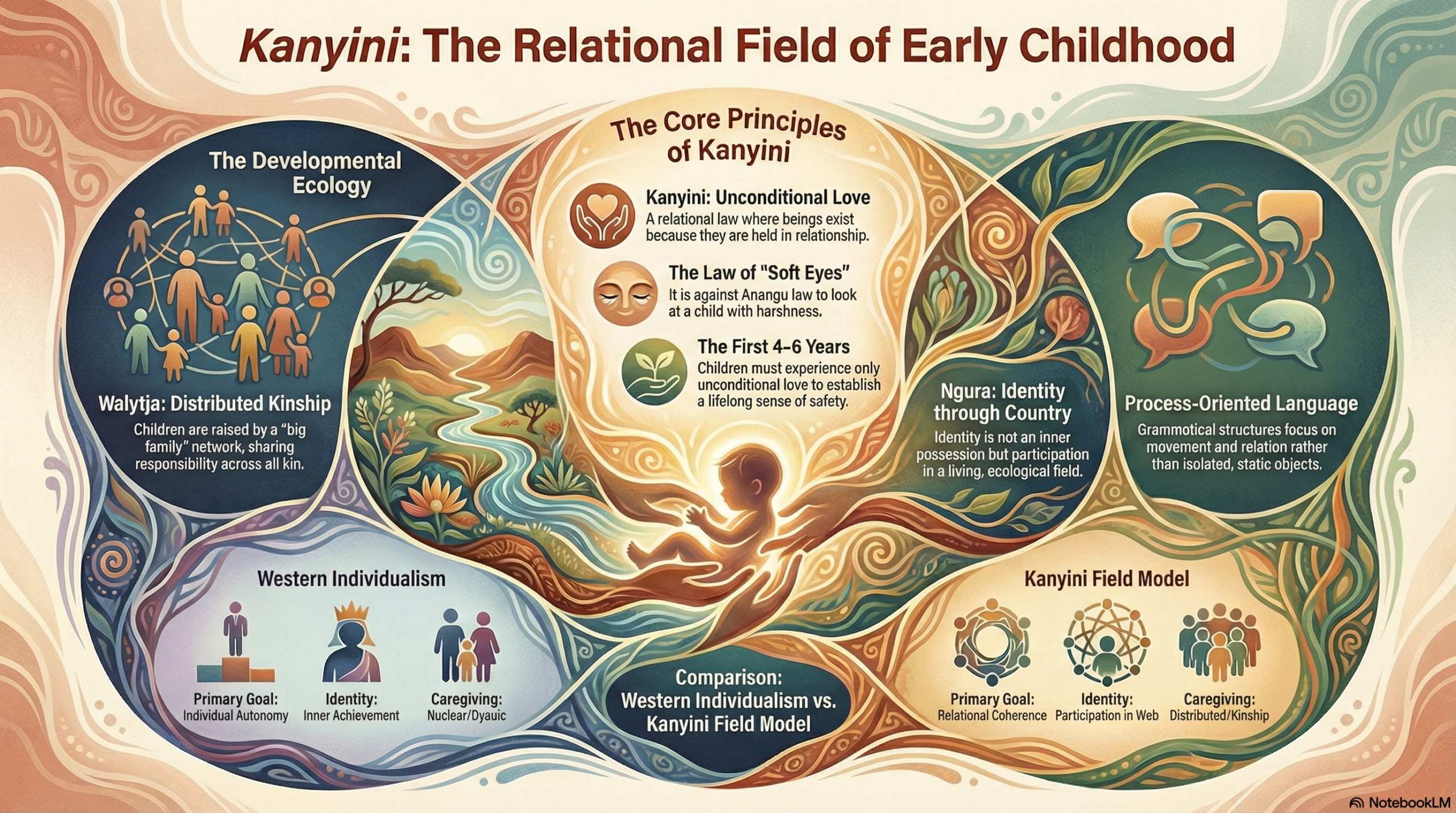
We introduce Kanyini, the Anangu philosophical framework that redefines early childhood as a relational ontology rather than a journey toward individual independence. Grounded in the teachings of Elder Tjilpi Bob Randall, this model emphasizes that a child’s identity emerges from an unbroken field of unconditional love, shared kinship responsibility, and a deep connection to the land. We contrast this Indigenous “field model” with Western psychological theories, arguing that developmental coherence is established through gentle affective presence and a language that prioritizes process over static objects. Central to this worldview is the legal requirement of gentleness, where avoiding “hard eyes” protects the child’s foundational sense of belonging within the cosmos. Ultimately, we illustrates how ruptures to Kanyini, such as those experienced by the Stolen Generations, cause profound ontological damage that can only be repaired through restoring these core relational webs. This synthesis suggests that modern developmental science can be expanded by recognizing that the self is a participation in a living, interconnected whole.