
01
Indigenous Knowledge & Relational Ontology
Exploring relationships with Country, community, culture, kinship, and the living world.
What does it mean to belong?
Research Questions
- What does it mean to belong?
- How do humans participate in relationships with Country, community, culture, and the living world?
- How does belonging influence identity, wellbeing, and human flourishing?
- How do Indigenous knowledge systems deepen our understanding of relationship and responsibility?
- How do dialogue, reciprocity, and care transform communities?
- What conditions allow belonging to emerge, persist, or fracture?
- Can belonging become a foundation for ecological and social renewal?
Current Research
Country and identity
Migration and belonging
Dialogue and relationality
Community wellbeing
Loneliness and social connection

project 1
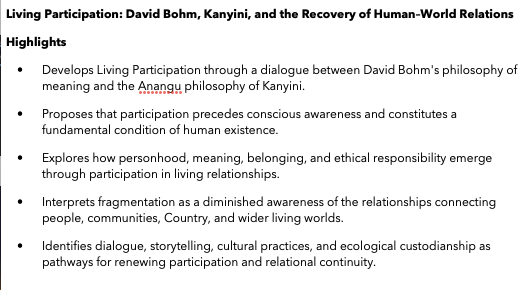
Living Participation: David Bohm, Kanyini, and the Recovery of Human–World Relations
Brings Bohm’s concept of participation into dialogue with Kanyini to explore the restoration of human–world relationships.
project 2
Ubuntu and Kanyini: Toward a Relational Ontology of Belonging
Brings African and Australian Indigenous traditions into dialogue around belonging, relationship, responsibility, and care.
project 3
Kanyini, Mitákuye Oyás’iŋ, and Indigenous Ontologies of Belonging Across Continents
Compares Australian and North American Indigenous philosophies of kinship, relationship, care, and responsibility.
project 4
Living Continuity: Anangu and Māori Thought on What Comes Before, Through, and Beyond Us
Explores how Anangu and Māori relational traditions sustain continuity across generations, places, relationships, and forms of life.
project 5
Resonant Knowledge vs Linear Knowledge
Contrasts relational and participatory ways of knowing with linear models of knowledge and information.
project 6
Knowledge That Walks
Explores knowledge as a lived and embodied practice sustained through participation, relationship, and responsibility.
project 7
Holding Without Holding
Investigates Indigenous approaches to custodianship grounded in care, responsibility, relationship, and non-possession.
project 8
When Science Overreaches
Examines the limits of scientific reductionism and the possibilities created through dialogue with other knowledge traditions.
project 9
Relational Ontology as Structural Recurrence
Develops a relational ontology connecting recurrent structures across science, philosophy, Indigenous knowledge, and spirituality.